Justice & Administration | Topics & Trends
This article shows what opportunities law firm digitization offers, what challenges need to be considered and what factors are important for successful implementation.
Every law firm faces its own challenges when it comes to digitalization. A well-founded analysis of existing processes forms the basis for meaningful optimization. With the right strategic support, digital potential can be exploited in a targeted manner and risks minimized. This creates a resilient digital infrastructure that meets the requirements of the legal market today and in the future.
Law firm digitization: both an opportunity and a challenge?
Digitalization is no longer an optional topic for the future. It is a key competitive factor in the legal market. Potential clients are increasingly comparing digital services and expect smooth, efficient communication.
At the same time, law firms are facing increasing demands:
- Growing cost pressure
- Complex regulatory requirements
- High expectations in terms of speed and service quality
The challenge is to combine these requirements. This is precisely where process-oriented digitalization comes in.
In essence, this is what it is all about:
- Reduce manual and error-prone processes
- Collect information in a structured and timely manner
- Integrate systems in such a way that data is consistently available
Digitalization is thus becoming a strategic instrument for efficiency, quality and future security.
What does law firm digitization mean in concrete terms?
Digitization is more than just switching from paper to digital documents. It encompasses the entire value chain of a law firm.
Digital mandate acceptance and communication
A key lever lies in the structured acceptance of mandates. In many law firms, clients are still accepted via unstructured emails or telephone calls. This leads to:
- incomplete information
- numerous queries
- Loss of time with the drop system
This is precisely where digital solutions such as Justin Legal come in. They enable a guided, standardized mandate intake via digital forms.
The effect: complete data records right from the start, significantly less coordination effort, faster processing and higher data quality. This transforms the acceptance of mandates from a bottleneck to an efficiency driver.
Document management and file management
Another key component is the structured management of documents. However, digital files alone are not enough. It is crucial that documents are stored in an automated and traceable manner.
Solutions such as FYDLOX address precisely this point by enabling automatic and rule-based archiving.
This results in:
- Consistent filing structures
- Reduced manual activities
- Greater traceability
Document management is thus transformed from an operational task into a stable component of the digital infrastructure.
Automation of routine processes
Many activities in law firms and notary’s offices follow recurring patterns:
- Document creation
- Deadline management
- Standard communication
Automation can not only speed up these processes, but also standardize them. In the notary’s office in particular, mandates always follow the same criteria. Notary software such as NOAH knows the necessary steps and guides you through client acceptance, document creation and execution.
It is important to note that automation only unfolds its full benefits if the underlying data is available in a structured form. This is precisely where Justin Legal‘s close integration with the digital acceptance of mandates comes into play.
Integration of specialist procedures and systems
An often underestimated success factor is system integration. Many law firms have several parallel systems that do not communicate with each other. This leads to multiple data entry, inconsistent information and unnecessary work steps.
A modern IT architecture ensures that:
- Data is centrally available
- Systems work seamlessly together
- Media discontinuities are avoided
In the notarial sector in particular, solutions such as NOAH show how specialized specialist procedures can be integrated into an end-to-end digital process landscape.
Typical challenges in law firm digitization
Despite the clear advantages, digitalization is failing or progressing slowly in many law firms. The reasons are often similar.
1. complex existing structures
Many law firms work with established systems and analog processes. These structures cannot simply be replaced. Law firm digitalization does not just mean new software, but a fundamental adjustment of workflows.
2. lack of strategic orientation
Digitization is often seen as an individual measure. Individual tools are introduced without creating an overall picture. This leads to isolated solutions that do not communicate with each other.
3. uncertainty regarding IT security and data protection
Data sensitivity is particularly high in the legal environment. Many decision-makers are reluctant to introduce new digital solutions because they fear risks.
4. acceptance in the team
Digitalization is changing working methods. Without clear communication and employee involvement, resistance arises. The introduction of new systems is then perceived as an additional burden.
IT security and data protection are prerequisites for law firm digitization
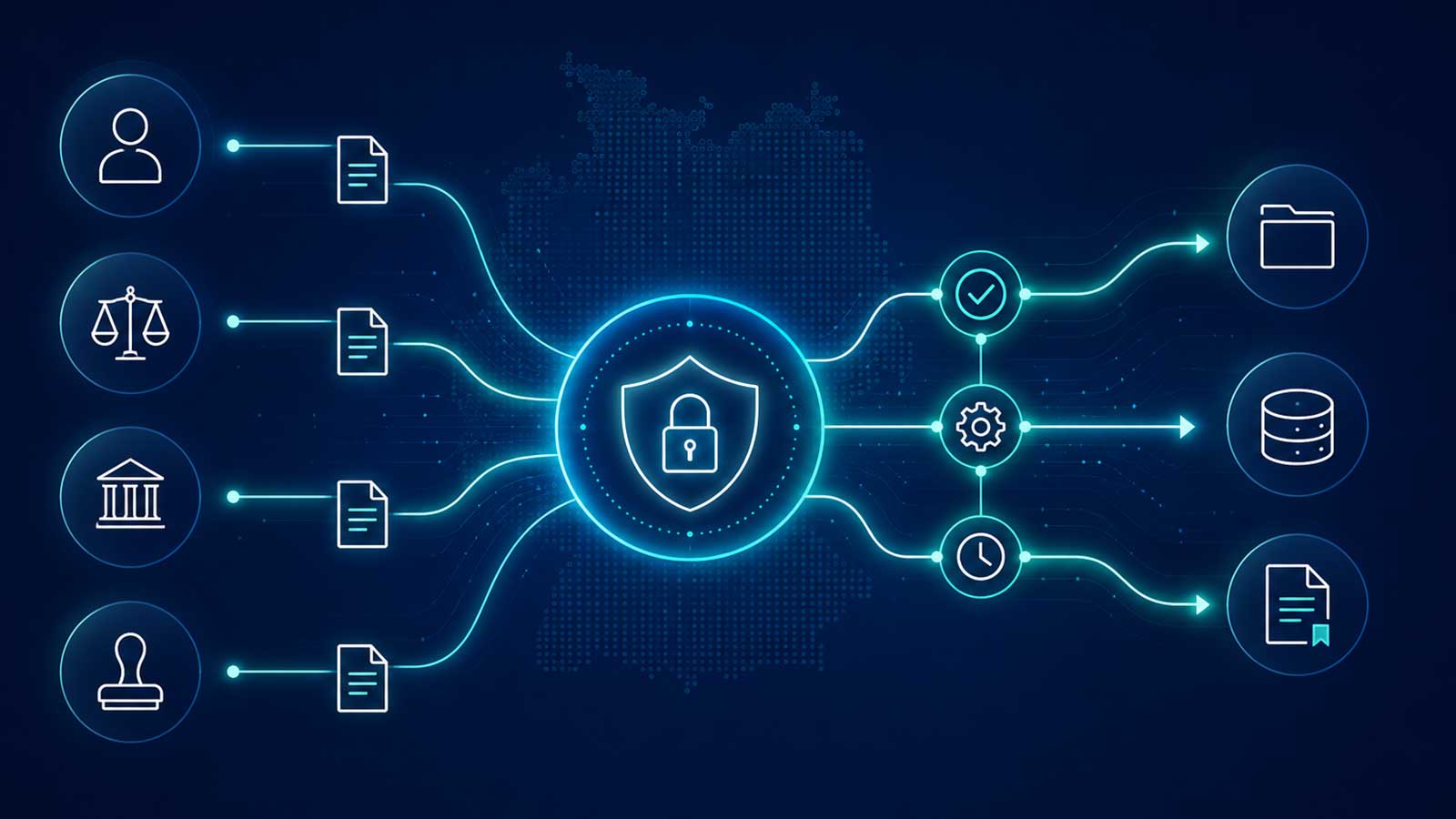
IT security and data protection have top priority in the legal environment. Digitalization must not make any compromises here. Law firms process confidential information. This must be protected against unauthorized access. This includes
- Encryption of data
- Secure access controls
- Regular security updates
Data protection laws and professional requirements set clear framework conditions here. Digital solutions must meet these requirements.
A secure IT infrastructure strengthens the trust of clients. It is therefore not only an obligation, but also a distinguishing feature in the market.

Digital solutions enable lawyers to process mandates more efficiently and work in a structured manner.
Law firm digitization: How to make it work step by step in your law firm
The digitalization of a law firm is a strategic process. Its success depends on several factors.
- Clear definition of objectives: First of all, it must be clarified which objectives are to be achieved. Is it about efficiency, better client communication or new business models? Only with clear goals can suitable measures be defined.
- Focus on specific use cases: Concentrate on specific areas in which you want to digitize, such as client acceptance or document management
- User-friendliness: Technology is only accepted if it can be used intuitively. Complex systems lead to frustration and are bypassed in everyday life.
- Employee involvement: Employees are a key success factor. They must be involved at an early stage. Training and transparent communication are useful and important.
- Collaboration with experienced partners: Choosing the right technologies and integrating them requires expertise. It makes sense to work with experienced IT partners such as Westernacher Solutions, especially when it comes to complex requirements.
A process-oriented approach has proven its worth in the legal environment in particular: Digitization along concrete work steps instead of abstract overall projects.
Digitalization brings new working models and opportunities to the legal market
Digitalization is not only changing processes, but also the way law firms work.
Enabling digital systems:
- location-independent working
- More efficient cooperation
- Faster coordination
At the same time, new technologies are opening up additional potential. Applications in the field of automation and data processing are already providing support in the analysis and structuring of legal content.
In the long term, this creates a networked, integrated system landscape that reduces media disruptions, accelerates processes and enables new business models. With the services and solutions from Westernacher Solutions, we therefore support you in actively embracing digitalization.
Conclusion
Law firm digitization is not a question of individual tools, but of the targeted optimization of central processes.
The interface between law firm and client in particular offers decisive efficiency potential. The digital acceptance of mandates is a central starting point. In combination with automated document management and integrated specialist systems, an end-to-end digital infrastructure is created.
Law firms that pursue this approach not only create more efficient processes. They lay the foundation for a modern, efficient and future-proof organization in the digital legal market – and position themselves as reliable partners for their clients in the long term.
The digitalization of legal processes requires not only technical know-how, but also a deep understanding of legal frameworks and sensitive data structures. If you want to future-proof your law firm, you will benefit from a structured, holistic approach. It pays to rely on expertise at an early stage in order to develop individual solutions that sustainably combine efficiency, security and compliance.