Justice & Administration | Topics & Trends
For many organizations, this raises a key question: How can electronic legal transactions be implemented in a way that delivers real efficiency gains while reliably meeting legal requirements?
In this article, we’ll explore the significance of electronic legal transactions today, the challenges that exist, and how structured digitization creates tangible added value.
Every organization has its own unique processes and requirements. A structured analysis of existing processes provides clarity on potential efficiency gains and risks. Westernacher Solutions supports you with customized solutions that target precisely those areas where optimization delivers real added value.
What is electronic legal communication?
Electronic legal communication (ERV) refers to the secure and legally valid digital exchange of documents and information between the judiciary, government agencies, citizens, and organizations, as well as professionals involved in legal proceedings, such as attorneys, notaries, and tax advisors. The goal is to replace communication, which has thus far been predominantly paper-based, with electronic processes.
The focus is on:
- Electronic documents instead of paper files
- secure transmission channels
- standardized interfaces
- automated processing procedures
For you, this means fewer media breaks, faster processing times, and greater transparency at every stage of the process.
Electronic Legal Transactions as an Opportunity
Legal requirements and technological advancements are driving the digital transformation —and, consequently, the mandatory use of electronic legal transactions. At the same time, clients, companies, and government agencies have increasingly high expectations for fast and transparent communication.
Organizations and institutions face several challenges in this regard:
- A rising number of cases amid limited resources
- complex legal requirements regarding form and deadlines
- growing pressure to digitize internal processes
Electronic legal transactions offer a clear opportunity here : they speed up processes, reduce media discontinuities, and make information available in a structured format.
Essentially, this involves, among other things, processing incoming documents digitally and automatically, reliably monitoring deadlines, and documenting communication in a traceable manner. When implemented correctly, electronic legal communication thus becomes a factor in competitiveness and efficiency.
What applications and email accounts are used in electronic legal communications?
In electronic legal transactions, various secure communication solutions are used, depending on the professional group and area of application.
Attorneys communicate with courts and other parties to proceedings via the special electronic attorney mailbox (beA). Public authorities have access to the special public authority mailbox (beBPo), notaries to the special electronic notary mailbox (beN), and tax advisors to the special electronic tax advisor mailbox (beSt).
In the notarial sector, the XNotar application also supports the electronic submission of applications to the registry and land registry.
Together, these various solutions form the technical foundation for secure and legally compliant digital exchanges with the judiciary.
Electronic Legal Transactions: Legal Foundations and Requirements
Electronic legal communication is not a voluntary luxury, but is increasingly required by law. In Germany, the basis for this is provided in particular by the rules of procedure and specific regulations governing electronic communication.
Important requirements include, for example:
- Use of Secure Transmission Channels
- Compliance with defined file formats
- qualified electronic signatures
- Archiving in Compliance with Audit Requirements
These requirements ensure legal certainty, but at the same time increase the complexity of implementation. Without appropriate software solutions, inefficient siloed systems or security risks can quickly arise.
IT Security and Data Protection in Electronic Legal Transactions
Sensitive data plays an important role in electronic legal transactions. That is why IT security and data protection must be at the heart of every solution and taken into account from the very beginning.
In our view, key aspects include, among others:
- secure authentication methods
- Access Controls and Role Models
- End-to-end encryption
- Archiving in Compliance with Audit Requirements
As a provider of digital solutions for the legal market, we know that the software we use must not only be functionally sound but also meet the highest security standards in order to comply with the stringent regulatory and security requirements in Germany and Europe. For this reason, Westernacher Solutions develops digital solutions specifically tailored to these requirements. Security is integrated into the architecture from the very beginning, rather than added as an afterthought.
Step by Step Toward Electronic Legal Transactions: Here Are the Benefits and Features
Electronic legal proceedings encompass much more than just the secure transmission of documents. They refer to digital communication among all parties involved in a proceeding.
Digital Client Onboarding as a Starting Point
An important component of electronic legal communication is the structured collection of data. With software such as Justin Legal, the client onboarding process is fully digitized. Information is captured directly online, stored in a structured manner, and processed automatically. Electronic legal communication therefore does not begin with the sending of documents, but rather with the initial data collection.
Electronic Mail and Communication
Legal briefs, motions, and documents are submitted electronically. Clear technical and legal requirements apply in this process. Unstructured communication quickly leads to problems:
- missing or incorrect information
- Delays Caused by Follow-Up Questions
- Risks Associated with Deadlines
Digital solutions ensure structured workflows in this area. Information is fully captured at the time of creation and transmitted in the correct format.
Notary offices, in particular, face complex challenges. They handle sensitive data, must comply with strict legal requirements, and work with a wide range of parties. The NOAH notary software offers a comprehensive solution for digital legal transactions in notary offices. This reduces errors while paving the way for faster processing and greater reliability.
Structured data instead of disorganized documents
A key factor in the success of electronic legal transactions is the structure of data. Traditional documents often contain information that must first be processed manually.
Digital systems such as our notary software NOAH rely instead on:
- standardized data formats
- automated validations
- Direct processing in specialized systems
This results in a significant gain in efficiency, especially when the workload is high. Information is immediately available where it is needed.
Digital Records Management and Archiving
Electronic legal proceedings only realize their full benefits when combined with digital case management. Simply digitizing paper files is not enough. It is important that:
- structured filing system
- automated assignment
- Archiving in Compliance with Audit Requirements
Modern solutions such as FYDLOX enable rule-based archiving, in which documents are automatically classified and stored. This results in clear filing structures, reduced manual work, and greater traceability in practice. Digital files thus become a central component of efficient work processes.
Automation of routine processes
Many processes in the legal field follow set patterns:
- Incoming Processing of Legal Documents
- Calculation of Deadlines
- Standard communication
Electronic legal transactions lay the groundwork for automation. Once data is available in a structured format, processes can be optimized in a targeted manner.
In this context, automation does not mean a loss of control, but rather targeted support in day-to-day work. This not only increases efficiency, but also lightens the workload for skilled workers and reduces errors.
Integration into existing systems
One aspect that is often underestimated is system integration. Many organizations have multiple parallel applications.
Without integration, the following will result:
- duplicate data entry
- inconsistent information
- unnecessary delays
A well-designed IT architecture ensures that systems communicate with one another and that data is available centrally. This interoperability is particularly important in electronic legal transactions. It is the only way to avoid media breaks and design processes efficiently.
Electronic Legal Transactions: How to Get Started with Implementation
Based on our many years of experience developing software for the legal market, we know that the introduction of electronic legal communications requires a clear strategy and structured implementation.
Companies embarking on this path for the first time need to proceed step by step:
- Clearly Define Objectives: Define which processes need to be improved. This is the only way to identify specific actions.
- Focus on specific use cases: Start with clearly defined areas, such as your inbox or document management.
- User-friendliness: Systems must be intuitive to use. Only then will they be accepted in everyday life.
- Employee Engagement: Focus on transparent communication and training to foster acceptance.
- Collaboration with Experienced Partners: Complex requirements call for technical and domain-specific expertise. Experienced IT partners provide support in selecting, integrating, and operating suitable solutions.
If you need assistance with implementing your IT architecture, our team at Westernacher Solutions will be happy to help you at any time.
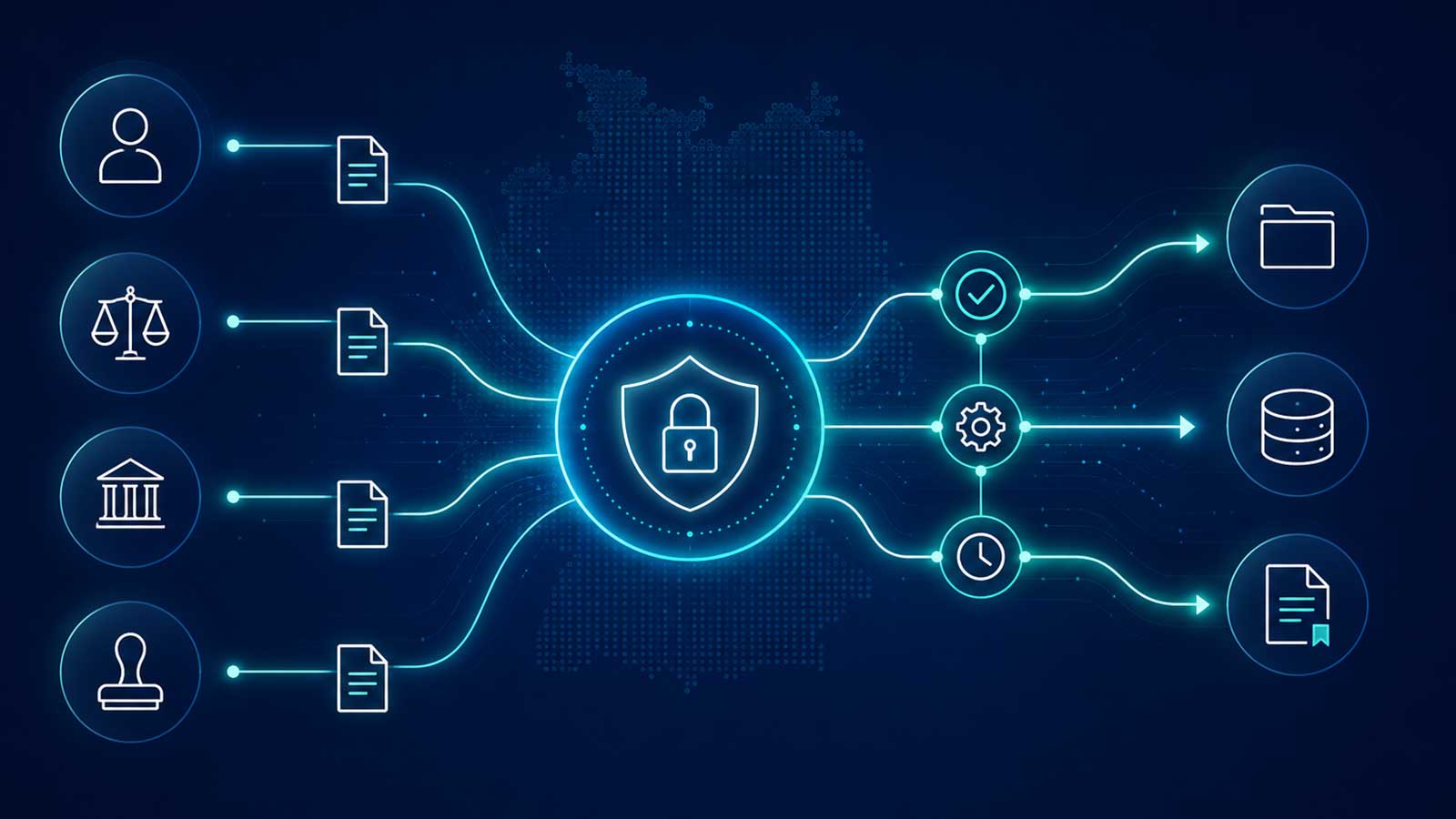
Secure digital communication as the foundation for efficient legal processes.
Digitalization as a Competitive Advantage in the Legal Market
Electronic legal transactions are changing not only individual processes, but the entire way of working. Digital systems make it possible to:
- location-independent working
- Faster coordination
- better cooperation among stakeholders
In the long term, aninterconnected system landscape will emerge in which information is consistently available. Processes will become more transparent, faster, and more efficient. Organizations that actively shape this development will secure clear competitive advantages.
Conclusion
Electronic legal communication is much more than just a legal requirement. It forms the foundation for efficient, secure, and future-proof work processes in the legal field. We would be happy to help you take this important step!
Significant potential arises particularly at the interfaces between stakeholders. Those who leverage this potential in a targeted manner reduce effort, improve quality, and create a resilient digital infrastructure. In this way, electronic legal transactions evolve from a mere requirement into a strategic advantage —and enable a modern, high-performing organization in the digital legal market.
Electronic legal transactions require more than just technical tools. They involve integrated systems, data protection, and long-term stability. With solutions such as Justin Legal, NOAH and FYDLOX Westernacher Solutions GmbH creates a robust digital infrastructure for modern law firms and institutions.
FAQ on Electronic Legal Transactions
ALSO INTERESTING