News & Events | The company
For more than three decades, the German IT Law Conference has brought together representatives from the judiciary, academia, government, and the IT industry. Under the theme “Data, AI, and Law,” the 2026 conference focused in particular on the impact of artificial intelligence on legal practice.
The digitization of the justice system remains a key issue for the future
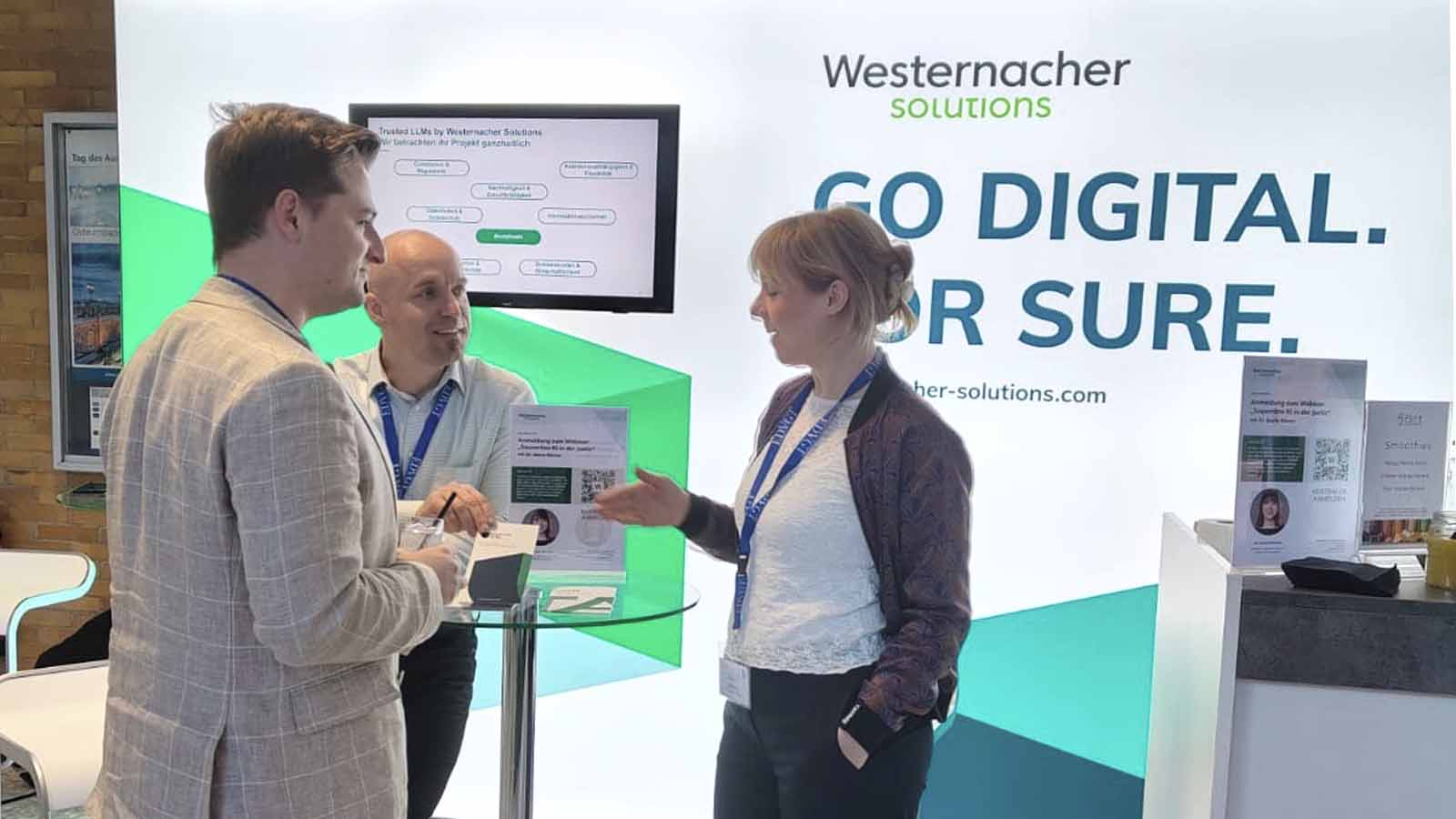
Westernacher Solutions was represented at the event with its own booth as an exhibitor. The goal of participating was to deepen dialogue with key players in the field of digital justice, gain a better understanding of the industry’s current needs, and showcase its own solutions for the digitization of legal processes. The EDV-Gerichtstag is one of the most important events for the target groups that Westernacher Solutions also serves: courts, ministries of justice, judicial administrations, notary offices, and other public sector institutions.
The event met our expectations: Numerous conversations with experts and decision-makers confirmed that the digitization of the justice system is continuing to gain momentum. There was particularly strong interest in technologies that can make existing processes more efficient and reduce the administrative workload on staff.
AI Is Becoming a Catalyst for Specialized Legal Procedures
A key topic of discussion was how specialized procedures can be accelerated in the future through the use of AI. Many stakeholders are currently grappling with the challenge of balancing rising case loads, limited personnel resources, and high quality standards.
At the same time, perspectives on artificial intelligence are increasingly shifting. While discussions in recent years have often centered on fundamental opportunities and risks, the focus in Saarbrücken has increasingly been on specific application scenarios. These include, for example, support for research, the analysis of large volumes of documents, and the automated processing of information for legal decisions. In many places, the question is no longer whether AI should be used, but how its use can be structured in a way that is legally compliant and allows for human autonomy.
Bias Remains a Challenge for Trustworthy AI
Dr. Maria Börner, Head of the AI Competence Center at Westernacher Solutions, made an important contribution to this discussion. As a speaker in the official technical program, she joined other experts in discussing the topic “Bias and the Legal Use of AI—Neutrality Is Not a Property of Training Data.” The focus was on the risks posed by biased training data and their potential impact on legal decisions.
The discussion made it clear that the quality and origin of training data will play an even more important role in the future. While AI systems can provide valuable support, they also inherit existing biases from data sets or usage contexts. Therefore, especially in the sensitive field of the justice system, it is essential to use AI responsibly. Transparency, traceability, and the continuous review of results will become key prerequisites for the successful implementation of such solutions.
Cloud technologies are becoming increasingly important
Another topic that came up repeatedly in many discussions and professional events was the future role of cloud technologies in the judicial system. While there was often still some reluctance toward cloud models in recent years, a more nuanced perspective on the issue is increasingly emerging. Especially since the major, nationwide specialized judicial systems (including “GeFa” as a cloud pilot, as well as “dabag” and “AuRegis”) are moving toward a shared judicial cloud.
Many organizations are currently examining how modern platforms and cloud-based infrastructures can be reconciled with the high standards for data protection, information security, and digital sovereignty. The discussions at the EDV-Gerichtstag made it clear that cloud technologies will play a greater role in the judiciary in the future, especially if they meet the requirements for security and control.
Raising Awareness and Promoting Dialogue
For Westernacher Solutions, the focus was not only on technical discussions but, above all, on engaging with the digital justice community. Numerous expert discussions provided valuable insights into current challenges, future requirements, and the strategic direction of many institutions.
In addition, the planned webinar “Sovereign AI in the Judicial System” generated interest even during the event. Many attendees registered directly for the event, which will take place in October and during which Westernacher Solutions will provide a closer look at the practical application of sovereign AI solutions in the judicial sector.
Conclusion
The 2026 IT Court Conference demonstrated that the digitization of the judiciary is entering a new phase. Topics such as trustworthy AI, the prevention of bias, the modernization of specialized procedures, and the use of modern cloud technologies are increasingly shaping the agenda of courts, ministries, and IT decision-makers.
For Westernacher Solutions, the event confirmed that the demand for practical, secure, and future-proof solutions continues to grow. Face-to-face dialogue with stakeholders in the digital justice sector remains essential for translating technological developments into tangible benefits for the judiciary and public administration.